Vape.ch Switzerland Guide
Is e-cigarette vapour harmful to other people?
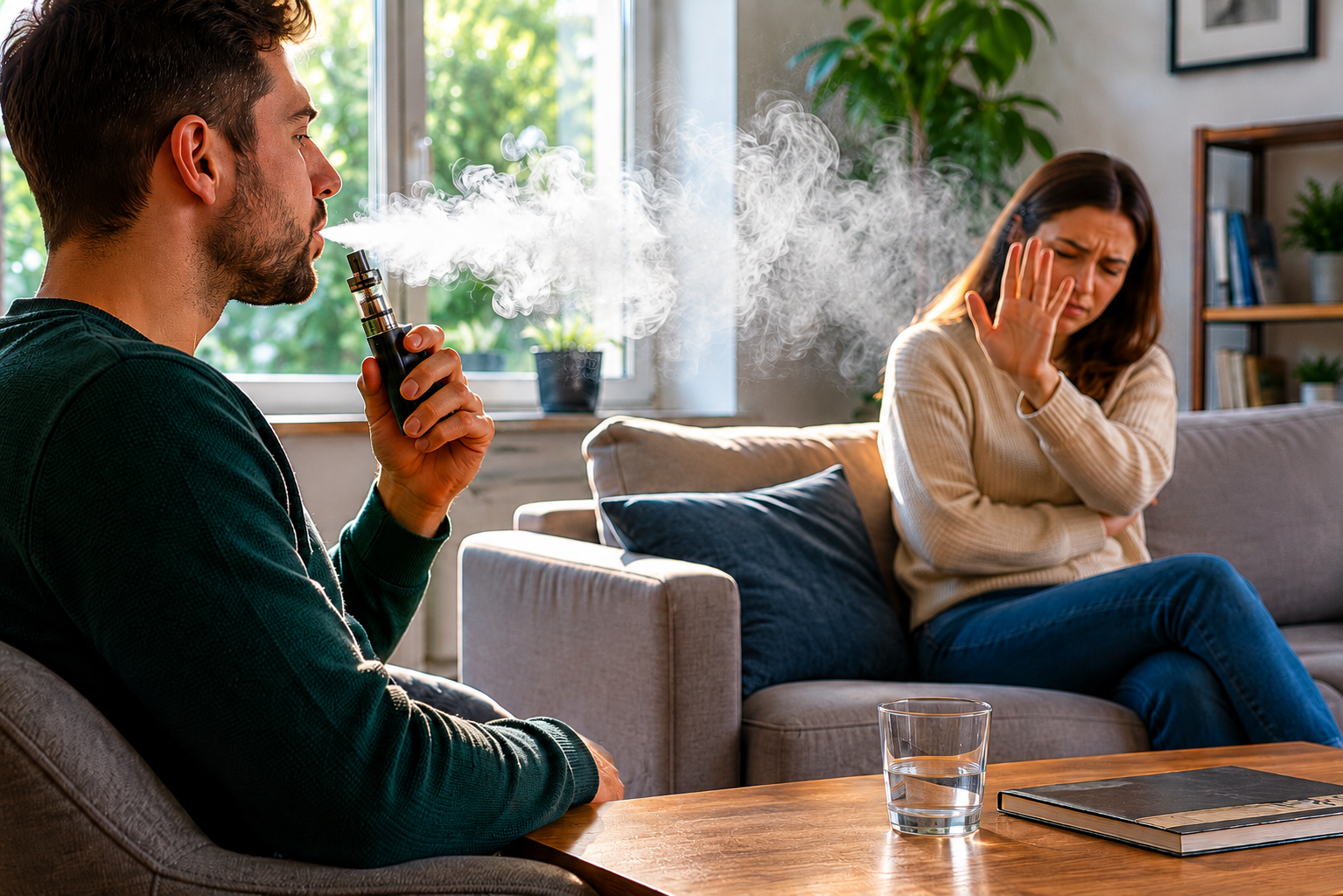
E-cigarettes do not create tobacco smoke. But the exhaled aerosol is not simply clean air either. People who vape should take others into account.
In brief
E-cigarettes do not produce tobacco smoke from combustion.
The aerosol can contain nicotine and other constituents.
Indoors and around sensitive people, caution and ventilation are the right approach.
The question “Is e-cigarette vapour harmful to others?” is common. The answer should not be dramatic, but it should also not be careless. E-cigarette vapour is not tobacco smoke, yet it is not simply water vapour.
A more accurate answer is this: vaping does not involve burning tobacco, so it does not create the same sidestream smoke as a lit cigarette. However, the user exhales an aerosol that can contain components of the liquid, including nicotine when the product contains nicotine.
Main point
Secondhand vaping is not the same as secondhand smoking. But “not the same as smoke” does not mean “irrelevant everywhere and for everyone”.
Why e-cigarette vapour is not tobacco smoke
A conventional cigarette burns tobacco. That process creates smoke, carbon monoxide, tar and many combustion products. It also creates sidestream smoke from the burning cigarette.
An e-cigarette works differently. It heats a liquid and creates an aerosol that is inhaled and then exhaled. No tobacco is burned. That is a central difference when comparing passive smoking and passive vaping.
Why it is still not just “water vapour”
In everyday language people often say “vapour”, but technically it is closer to an aerosol. It can contain substances from the e-liquid, such as propylene glycol, glycerin, flavourings and nicotine if the liquid contains nicotine.
How much reaches indoor air depends on device type, power, liquid, nicotine strength, puffing behaviour, room size, ventilation and frequency. A short puff near an open window is not the same as frequent vaping in a small closed room.
Too broad
“E-cigarette vapour is completely harmless to others.”
Better
“Exposure differs from tobacco smoke, but consideration and ventilation still matter.”
Who deserves extra caution?
Extra caution makes sense around children, pregnant people, non-smokers, people with asthma, respiratory problems or strong sensitivity to smells. These people did not choose to inhale aerosol components.
Even if the risk differs from tobacco smoke, consideration is the cleanest everyday rule: do not vape directly beside others, do not exhale towards people and ventilate indoor spaces.
Practical rule
Do not vape where others cannot move away: cars, small rooms, workplaces, children’s rooms or directly at the dining table.
Conclusion
E-cigarette vapour should not be equated with tobacco smoke. There is no burning cigarette, no classic sidestream smoke and no tobacco combustion.
But the aerosol is not pure air either. It can contain nicotine and other components. The serious position is: do not exaggerate, do not trivialise, ventilate indoor spaces and avoid exposing children, pregnant people, non-smokers and sensitive individuals unnecessarily.